
What started as an intervention has become a way of being for Fiona Jones and her colleagues. Fiona started with her clinical training as a physical therapist, which meant doing things “to” patient-persons. When she moved from hospital settings to home settings, she began to appreciate the variety of PT practices people had come up with on their own. She began to wonder, “what if we combined forces?”
Fiona shares her insights with Paul into the language and practices that help people navigate the continuum of support for self-care.
Guests
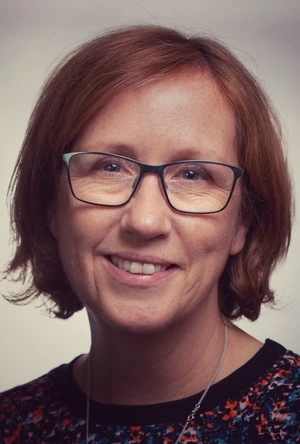
Fiona Jones
Professor, Rehabilitation Research, St George’s University of London and Kingston University. Founder and CEO, Bridges Self-Management Limited.
More about Fiona
Since developing Bridges, Fiona Jones has studied self-management support for people with acquired brain injury & long-term neurological conditions and professional factors influencing sustainability of programme use within rehabilitation. Fiona has published on self-management & self-efficacy, and supervises doctoral students in the UK and Sweden who study self-management. Fiona was Chief Investigator for ‘CREATE’, completed in 2020, and used Experience-Based Co-Design to increase therapeutic activity in stroke units. In 2009 Fiona received the life after stroke award for excellence from the UK Stroke Association. In 2011 she was made a Fellow of the Chartered Society of Physiotherapists and was President of the UK Association of Physiotherapists in Neurology from 2013-2017. She received a MBE award for services to stroke rehabilitation in the Queen’s Birthday Honours list in 2017.
Fiona speaks with Paul from her experience fostering support for self-care by health professionals.
Supplementary materials
Readings
Kulnik ST, Pöstges H, Townsend R, Micklethwaite P, Jones F. “A gift from experience: Co-production and co-design in stroke and self-management. “ Design for Health, available online: https://www.tandfonline.com/doi/full/10.1080/24735132.2019.1577524
Barbara Riegel B, Westland H , Iovino P , et al. “Characteristics of self-care interventions for patients with a chronic condition: A scoping review.” Int’l J. Nursing Studies 116 (2021) 103713. https://doi.org/10.1016/j.ijnurstu.2020.103713
Kirk S, Beatty S, Callery P, Gellatly J, Milnes L, Pryjmachuk S. “The effectiveness of self-care support interventions for children and young people with long-term conditions: a systematic review.”Child: care, health and development, 39:(3) 305–324. doi:10.1111/j.1365-2214.2012.01395.x © 2012
Wang C, Bakhet M, Roberts D, Gnani S, El-Osta A. “The efficacy of microlearning in improving self-care capability: a systematic review of the literature.”Public Health 186 (2020) 286e296. https://doi.org/10.1016/j.puhe.2020.07.007
Clarke, D., Gombert-Waldron, K., Honey, S., Cloud, G., Harris, R., Macdonald, A., McKevitt, C., Robert, G. and Jones, F. (2021) Clarke D, Gombert- Waldron K, Honey S, et al. Co- designing organisational improvements and interventions to increase inpatient activity in four stroke units in England: a mixed- methods process evaluation using normalisation process theory. BMJ Open 2021;11:e042723. doi:10.1136/ bmjopen-2020-042723